

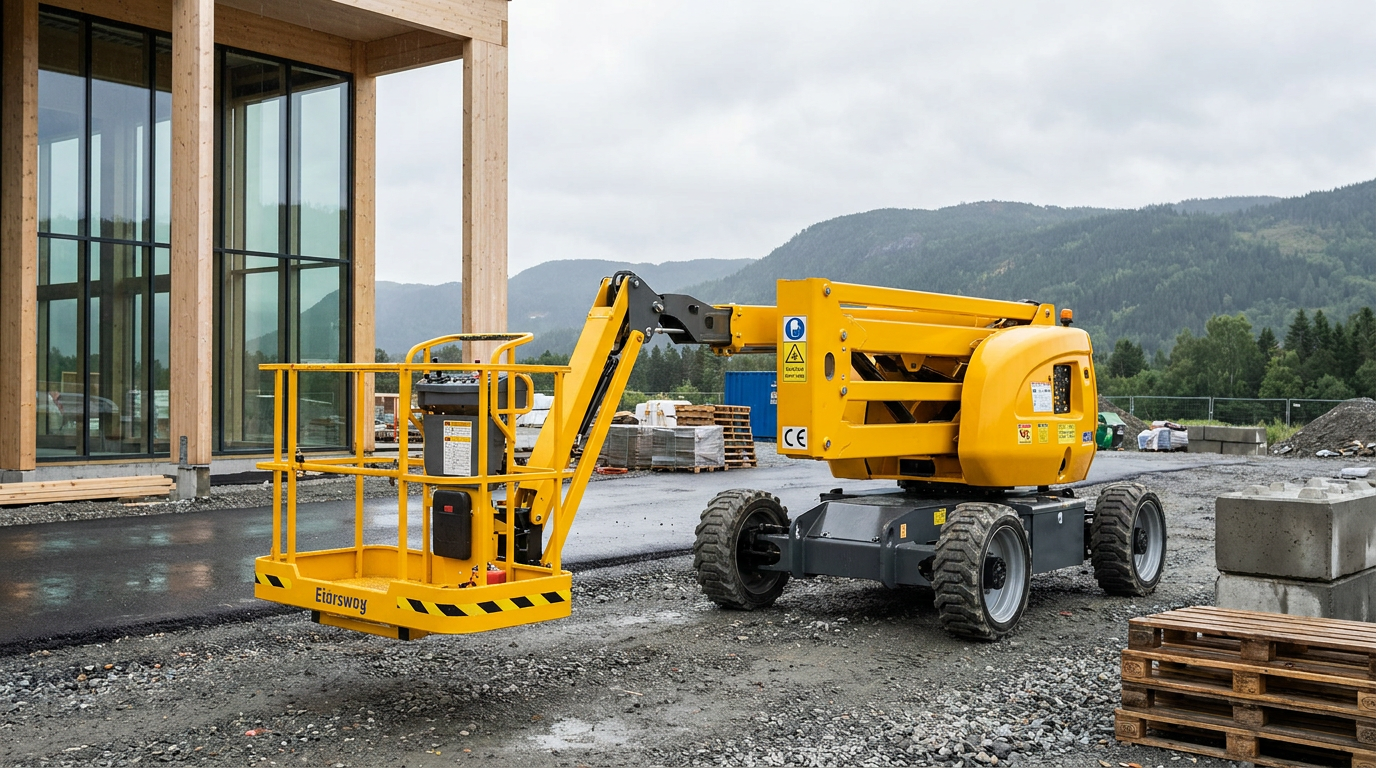
Personnel lifts are used in construction, industry, warehousing, operations, cleaning, events and many other settings. They make work at height more efficient, but incorrect lift selection, unstable ground, wind, crushing hazards or inadequate emergency preparedness can have serious consequences. Training must therefore be documented and adapted to the equipment and the task.
Take the MEWP theory course online
Our online course covers theory for personnel lifts in Groups 3A and 3B. See the current price in the online store. Practical and equipment-specific training is completed at the workplace.
View the course and start →
What do Groups 3A and 3B mean?
Group 3A covers mobile vertical lifts where the platform mainly moves vertically, including many scissor lifts. Group 3B covers mobile boom lifts where the platform can move beyond the machine's tipping lines. Practical training must match the group and type of lift the participant will actually use.
What training does a lift operator need?
The employer must ensure that safety training is documented when the risk assessment shows that the work equipment requires particular care. The Norwegian Labour Inspection Authority identifies personnel lifts as equipment for which the training record should specify the group and type of lift covered.
- Theoretical training: hazards, controls, stability, work methods, safety systems and emergency procedures.
- Practical training: supervised practice with the relevant group or type of lift.
- Equipment-specific training: operation, limitations, operating instructions, daily inspection and emergency lowering for the actual machine.
What must be assessed before work starts?
- the correct lift type, working height, reach and capacity
- ground conditions, point loads, outriggers, trench edges and decks
- wind, weather, traffic, high-voltage systems and other nearby activities
- crushing hazards, blind spots, falling objects and barriers
- communication, ground personnel, emergency lowering and rescue plans
- the manufacturer's requirements and the need for personal fall protection equipment
Is an MEWP course the same as a certified qualification?
Personnel lifts are normally covered by documented safety training, rather than certified safety training delivered by a certified training organisation. The online course certificate documents the theory section. The employer must also document practical training, equipment-specific instruction and an assessment of actual competence.
Is fall protection required in a lift?
This depends on the lift's operating instructions, the work method and the risk assessment. In a boom lift, a suitable system and short lanyard are often relevant to reduce the risk of ejection. In a vertical lift, the guardrail is normally the primary barrier, but local conditions and the manufacturer's instructions must always be followed.
Read the Norwegian Labour Inspection Authority's guidance on using personnel lifts.