

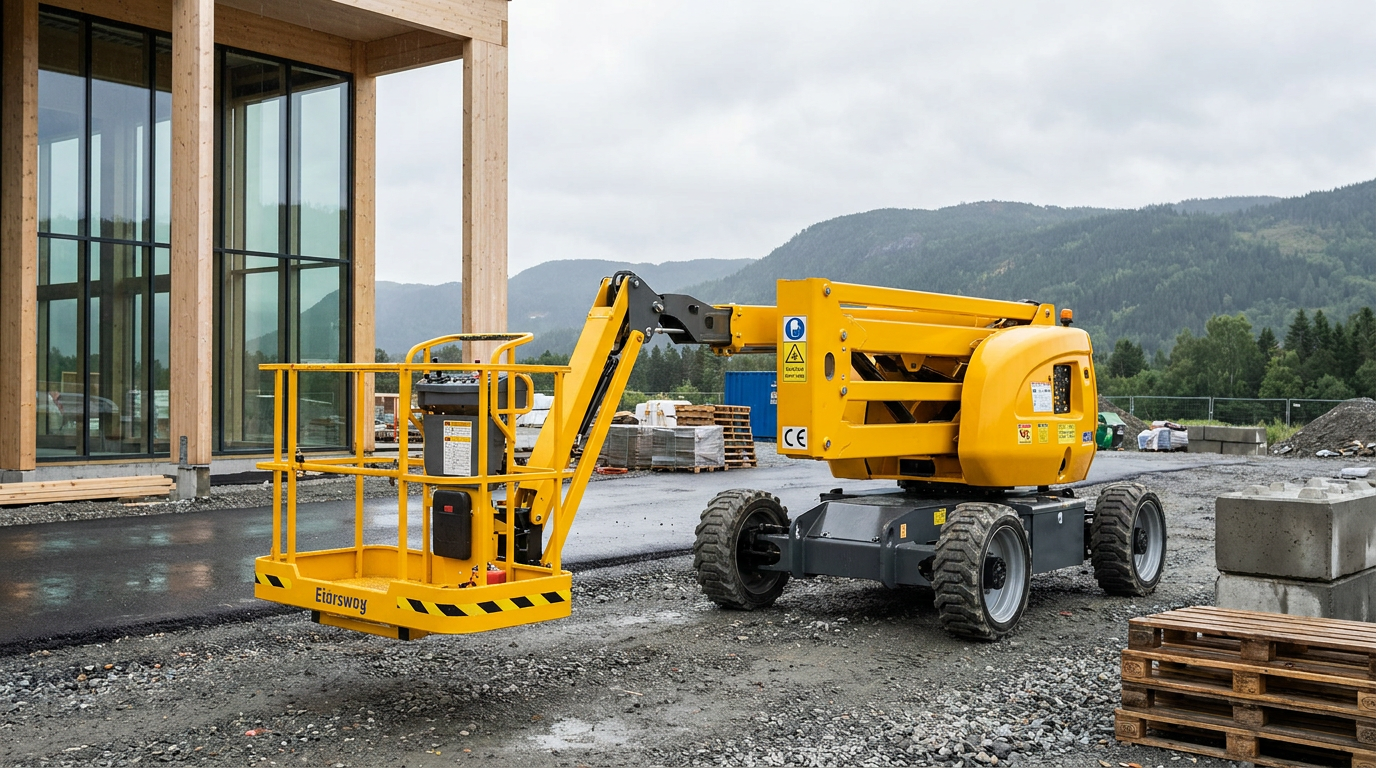
Take the theory course online—practice using the lift at work
Complete the training locally with a qualified instructor, such as a colleague or coworker with the necessary forklift training. The instructor will demonstrate, and you will practice control, setup, operation, and emergency functions on the specific forklift. Your employer will document the training and evaluate your skills before you operate the lift independently.
The mentor does not need to have taken our course. The training must cover the lift group and the lift you will be using. Follow the user manual, review local hazards, and practice emergency lowering and relevant rescue procedures. Training in personal fall protection equipment is included when the user manual and the work require it.
Personnel lifts are used in a wide range of settings, from construction and industry to warehousing, operations, cleaning, and events. These machines make working at heights more efficient, but choosing the wrong lift, unstable ground, wind, the risk of being pinched, or a lack of emergency preparedness can have serious consequences. Therefore, training must be documented and tailored to the equipment and the specific task.
Take the lift theory course online at
. Our lift course covers the theory for 3A and 3B personnel lifts. See the current price in the online store. Hands-on, equipment-specific training is conducted at the workplace.
View the lift course and get started →
What do 3A and 3B mean?
Group 3A applies to mobile vertical lifts where the platform moves primarily in a vertical direction, such as many scissor lifts. Group 3B applies to mobile boom lifts where the platform can move beyond the machine’s roll-off edges. The practical training must correspond to the group and type of lift the participant will actually be using.
What kind of training does the lift user need?
The employer must ensure that safety training is documented when the risk assessment indicates that the work equipment requires special caution. The Norwegian Labor Inspection Authority emphasizes that personnel lifts are a type of work equipment for which training must be documented, specifying the group and type of lift to which it applies.
- Theoretical training: hazards, controls, stability, work methods, safety systems, and emergency procedures.
- Hands-on training: supervised practice with the specific group/type of lift.
- Equipment-specific training: operation, limitations, user manual, daily inspection, and emergency lowering procedure for the specific machine.
This must be considered before work begins
- the right type of lift, working height, reach, and capacity
- subgrade, point load, support legs, ditch edges, and covers
- wind, weather, traffic, high-voltage power lines, and other activities in the area
- Risk of pinching, blind spots, falling objects, and obstructions
- communication, ground crew, emergency descent, and rescue plan
- the manufacturer's requirements and the need for personal fall protection equipment
Is a ski lift course the same as a certificate?
Patient lifts are typically subject to documented safety training. Complete the theory portion online and the practical portion locally with a qualified mentor. The employer documents the training and assesses the employee’s skills before allowing independent use.
Is fall protection required when using a lift?
This is determined by the lift’s operating instructions, the work method, and the risk assessment. For boom lifts, securing the load with a suitable system and a short rope is often necessary to reduce the risk of ejection. In vertical lifts, the guardrail is normally the primary barrier, but local conditions and the manufacturer’s instructions must always be followed.
Read the Norwegian Labor Inspection Authority's guidance on the use of personnel lifts.
Would you like to take the ski lift course?
See the price and the most important information you need to know all on one page.
Simple: Select the quantity, add it to your cart, and complete your order. If you need help, give us a call.