

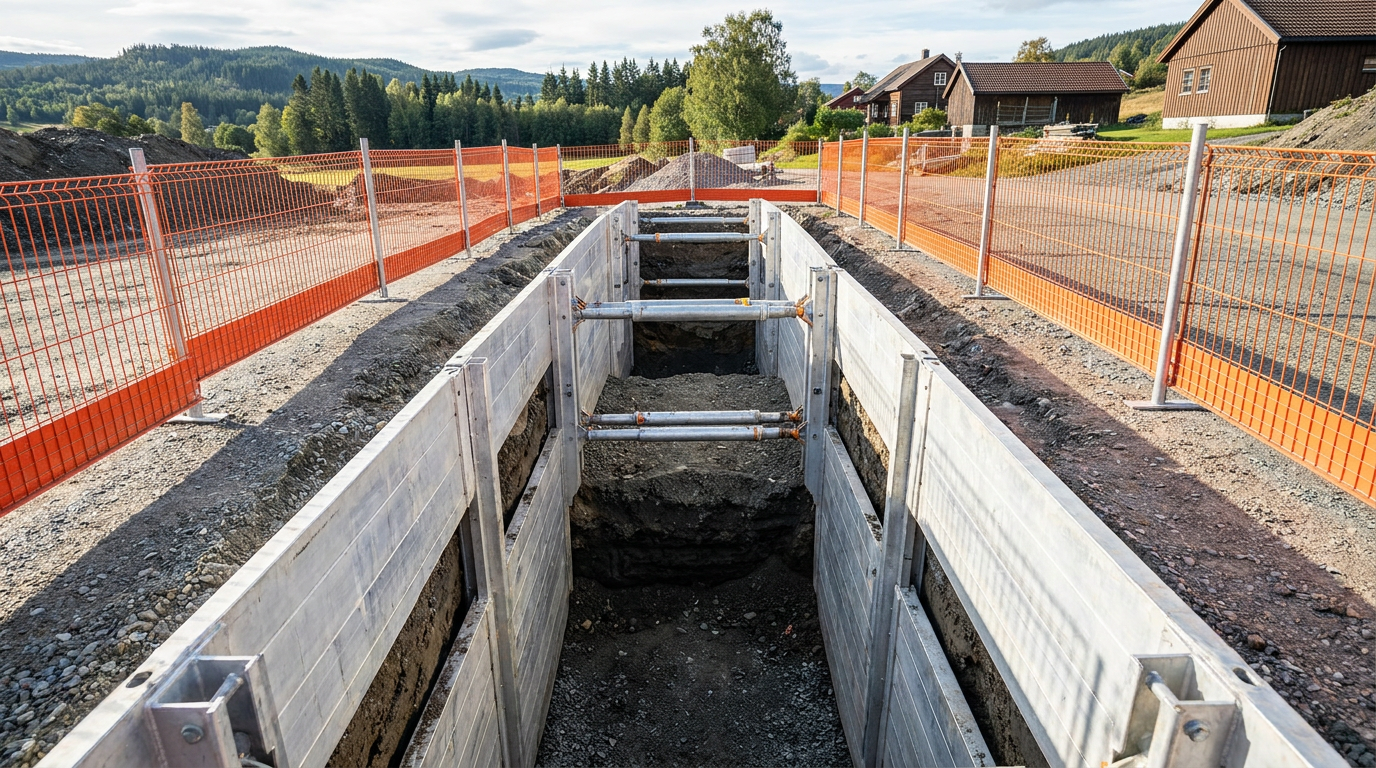
Take the theory course online—go through the trench at your workplace
The employer must provide on-site training with a qualified person before work begins. Review site conditions, safety measures, access, escape routes, installations, and the equipment you will be using. Practice tasks and emergency procedures as needed, and document the training.
The on-site review must be appropriate for the specific trench and work method. A trench-digging course does not qualify a person to operate heavy equipment. The operation of an excavator is subject to separate training requirements.
Trench work can involve landslides, falls, water ingress, damage to cables and pipes, traffic hazards, and hazardous atmospheres. Therefore, the work must be planned and assessed for risks before anyone enters the trench. A trench work course can provide a solid theoretical foundation, but the employer must also ensure that local, hands-on training is provided that is tailored to the work methods and on-site conditions.
Is a ditch-digging course required by law?
The regulations require employers to provide the necessary training, instruction, and ensure safe implementation. This does not necessarily mean that the regulations use the specific course name “trench course” for all roles. The need must be assessed based on the job duties, the risks, and the employee’s responsibilities.
The course should therefore be part of a comprehensive program that also includes the project's risk assessment, work instructions, emergency preparedness, and a practical walkthrough at the worksite.
The training should cover the following
- soil conditions, landslide risk, and the effects of weather and water
- Planning the excavation work and selecting a safety method
- Safe access, escape routes, and order around the ditch
- placement of excavated material, machinery, and other loads
- cables, pipes, contaminants, and potentially hazardous atmospheres
- Traffic and work notifications when work is being done on the road
- Monitoring during work and handling changing conditions
- Emergency Preparedness, Communication, and Suspension of Hazardous Work
Before Work Begins
- Survey the ground conditions, utility networks, traffic, and nearby structures.
- Consider depth, geometry, water, and loads from machinery or soil.
- Choose a safe method for securing and accessing the site.
- Define responsibilities, checkpoints, and who can halt the work.
- Review the plan with everyone who will be participating.
- Training materials and local instructions.
Monitoring While Work Is in Progress
Conditions in a trench can change rapidly. Inspections must therefore be repeated whenever there are changes in weather, soil, depth, water level, machinery use, or work methods. Signs of movement, cracks, slippage, or failure of safety measures must be taken seriously. Work must be stopped if conditions are no longer safe.
Online Courses and Practical Follow-Up
A digital trench safety course can provide general theory and documented completion. It cannot, on its own, assess a specific trench. The employer must supplement it with a workplace risk assessment, instruction, and a practical review.
See relevant HSE and technical courses
Frequently Asked Questions
Who should take a ditch-digging course?
Individuals who plan, supervise, or perform trench work should have the necessary qualifications for their role and the associated risks. The employer determines the extent of these qualifications.
Are online courses enough on their own?
The online course can cover the theory. Local risk assessments, practical instruction, and on-site supervision must be provided in addition, as needed.
How long is the certification valid?
Employers must ensure that employees' skills are up to date. New training may be necessary if there are changes to tasks, equipment, methods, or regulations.
Updated August 15, 2026. Always follow current regulations and the project's risk assessment.
Would you like to take the ditch-digging course?
See the price and the most important information you need to know all on one page.
Watch the ditch-digging course
Simple: Select the quantity, add it to your cart, and complete your order. If you need help, give us a call.